


The Fruit Test
Why the "Fruit Test" Is the Only Metric That Matters in a Noisy World
The High Cost of the Attention Economy
We live in a world that has become exceptionally skilled at capturing our attention. It is a noisy landscape where "engagement" is the primary currency, and we are the product. On any given day, we are bombarded by a cacophony of voices—some sound deeply spiritual, others appear clever or confident, and many carry a manufactured sense of urgency.
In this environment, we often mistake discernment for mere direction-finding. We treat it like a GPS for our next move. But true discernment is less about where we are going and more about what we are becoming. To navigate the digital and spiritual noise, we must look past the volume and focus on the output.
Stop Judging the Tree by Its Appearance
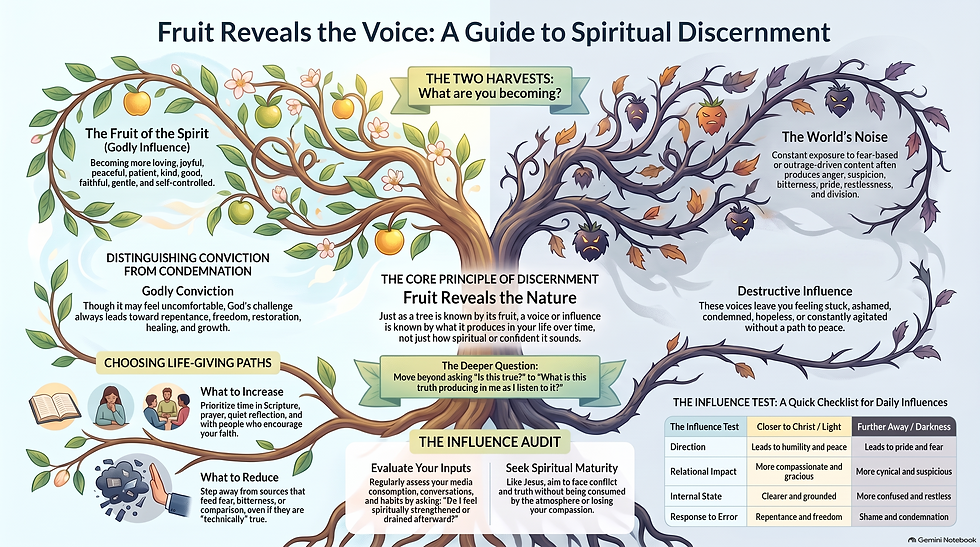
The most effective way to evaluate any influence—be it a person, a media source, or a recurring thought—is to apply an ancient principle: fruit reveals the nature of the tree. If you want to understand the true essence of an influence, you cannot rely on how impressive the branding appears on the surface.
Many voices are convincing at first glance. They may sound authoritative or even possess fragments of the truth. However, the external "package" is irrelevant if the internal output is flawed. Discernment requires us to look beyond the superficial and evaluate what an influence actually produces over time.
Attention Does Not Equal Spiritual Health
Modern media is meticulously engineered to exploit engagement loops. Algorithmic outrage, fear, conflict, and bad news are the primary drivers of the attention economy because they are designed to keep us scrolling. It is a common mistake to equate being "fascinated" with being "fed." Just because something captures your interest does not mean it is beneficial for your spirit.
This leads to a profound paradox: a headline can be factually accurate while being spiritually poisonous. Truth can be weaponized to create fear rather than freedom.
"Something can be fascinating and still be unhealthy for us. Something can be technically true and still be presented in a way that feeds fear, resentment or hostility."
The Most Important Question You Aren’t Asking
When we consume content or engage in relationships, we typically ask: "Is this true?" While accuracy matters, there is a deeper, more strategic question that reveals the source of the influence: "What is this truth producing in me?"
By auditing our internal state, we can identify which voices are leading us toward Christ and which are driving us into the desert. Ask yourself the hard questions the source material demands:
Am I becoming more loving and peaceful, or increasingly angry and suspicious?
Am I becoming more patient and grounded, or restless and divided?
Am I becoming more compassionate, or more cynical?
If a message makes you more arrogant or fearful, it is failing the fruit test, regardless of how "correct" the data might be.
Distinguishing Godly Conviction from Destructive Influence
Growth is often uncomfortable. God’s voice does not always offer an immediate hit of dopamine; it often challenges us, exposes pride, or reveals areas where we have harboured unforgiveness.
However, there is a sharp distinction between the discomfort of growth and the weight of a destructive influence. Godly conviction always leads toward a destination: repentance, freedom, restoration, and healing. Conversely, destructive voices—even those that sound "truthful"—leave you stuck, ashamed, condemned, or constantly agitated. The ultimate test of a challenge is whether it draws you closer to humility or deeper into resentment.
Spiritual Maturity Is "Atmosphere-Proof"
The ultimate model of spiritual maturity is found in Jesus. He lived in a world of intense conflict, yet He remained the calmest person in the room. He was never defined or consumed by the atmosphere around Him.
He stood in the centre of the storm and remained unmoved. He confronted truth without weaponising it; He faced wrongdoing without losing His compassion. This is the goal of the spiritual life: to be "atmosphere-proof." According to the Book of James, this "wisdom from above" is easily identified by its quality standards: it is pure, peace-loving, considerate, merciful, and full of good fruit.
The "Time-Release" Nature of Discernment
Discernment is rarely an instantaneous event because fruit takes time to grow. To accurately judge an influence, you must step back and look at the long-term pattern. You cannot judge a crop by the day it is planted.
Step back and evaluate the trajectory of your influences—your media habits, your social circles, your repeated conversations—over the last few months.
"Discernment is not only about choosing the right direction. It is about becoming the right kind of person while we walk that direction."
Conclusion: A UX Audit for the Soul
To maintain clarity in a digitally saturated world, we must conduct a practical User Experience (UX) audit of our daily lives. We must be ruthless with our inputs. If an influence—even one that claims to be "truth-telling"—is consistently making you more cynical, fearful, or proud, it is time to unfollow, mute, or delete.
The goal is to intentionally increase life-giving influences: more Scripture, more prayer, more quiet, and more time with those who encourage faith. We are the architects of our own internal environment.
Today, move beyond the surface of your information stream.
Don’t just ask: "What am I listening to?" Ask: "What is it producing in me?"


Comments