


Kindness

The Radical Power of "Small": Why Kindness is More Than Just Good Manners
We often treat kindness like our "Sunday best"—something we put on to look presentable in polite company—when it was actually designed to be the work clothes of the soul. In our modern social landscape, kindness is frequently dismissed as a minor virtue or a lubricant for social friction, little more than saying "please" and "thank you." But as we explore the call to "Walk in Kindness," we discover a radical paradox: kindness is not a social requirement; it is a spiritual revolution. It is a powerful, visible manifestation of faith that moves far beyond the borders of simple etiquette.
Kindness as Evidence, Not Just Etiquette
There is a fundamental theological distinction between being well-mannered and being kind. Etiquette is often a performance—an external set of rules we follow to maintain our reputation or ensure social safety. Kindness, however, as outlined in Galatians 5, is a "fruit of the Spirit." As a practical theologian might observe, fruit is not manufactured by manual labor of the will; it is grown as a supernatural byproduct of the life within the tree.
When we act with genuine kindness, we are offering evidence of internal transformation. It is proof that the Holy Spirit is doing a deep work within us, refining our rougher edges and replacing self-interest with a heart for others. While politeness is performed for the benefit of the performer, the fruit of kindness is produced for the benefit of the recipient. It is the difference between social obligation and spiritual vitality.
So kindness is not simply good manners. It is evidence that God is doing something inside us."
The "Inconvenience" Litmus Test
The true potency of kindness is rarely revealed when life is easy. It is easy to be gracious when we are ahead of schedule and feeling refreshed. The defining characteristic of "Christian kindness," however, is its cost. It is found in the moments when we are busy, exhausted, or interrupted by someone "awkward." This is the "inconvenience litmus test."
When we choose kindness in the face of our own fatigue, we are mirroring the radical character of Jesus. He did not just help those who were convenient to His schedule; He intentionally stopped for the interrupted, touched the lepers whom others avoided, and welcomed the outcasts whom society rejected. By choosing to be kind when it costs us time or energy, we make a profound theological statement: "You matter more than my convenience." This shift transforms a casual gesture into a sacrificial act, grounding our behaviour in the command of Ephesians 4:32 to "be kind and compassionate to one another."
Making Faith Visible Through Treatment, Not Knowledge
In religious circles, we often measure success by traditional markers: church attendance, the depth of one's Bible knowledge, or the precision of one's doctrine. While these have their place, they are often invisible to the outside world. A neighbour may never see your open Bible, but they will always see your open schedule. The most compelling advertisement for the Gospel is not what we know, but how we treat the person standing right in front of us.
Consider the weight of "neighbourly testimonies" that arise when faith becomes visible through action:
"They are always helpful." (A testimony of availability.)
"They always make time." (A testimony of priorities.)
"They never make you feel like a burden." (This is the ultimate expression of grace—communicating that the recipient's needs are worth the cost of the giver’s time.)
"There is something different about the way they treat people." (A testimony of the character of Jesus.)
The Impact of the "Small and Quiet"
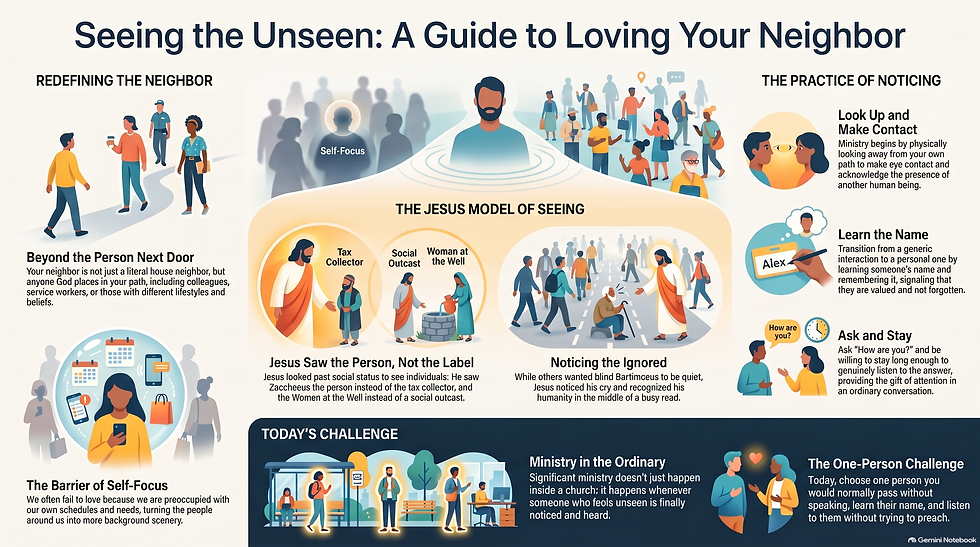
The kingdom of God often arrives in the "small and quiet." We see this in the practical, everyday acts that populate a life of faith: making a cup of tea for a grieving friend, sending a thoughtful text to a colleague, carrying a heavy bag for a neighbor, or simply noticing the person everyone else is ignoring.
There is a specific power in the "Quiet Challenge"—the act of doing good without seeking recognition. This echoes the humility of Jesus, who frequently performed miracles and then instructed the recipients to tell no one. When we act quietly, we ensure that our reputation remains secondary to the recipient’s dignity. It prevents the act from becoming a transaction of "thanks" and keeps it a gift of grace. A small act of kindness can carry a very big message.
Conclusion: A New Definition of Success
Ultimately, success in the Christian walk is found in becoming a visible reflection of Jesus. If He was moved by compassion to feed the hungry and notice the overlooked, then our kindness is the primary way His character becomes tangible in our neighbourhoods today.
As you move through your week, I invite you to sit with a difficult question: Where has kindness become inconvenient for you, and who in your circle needs you to choose them over your own comfort? Perhaps it is the neighbour who always talks a bit too long, or the colleague who is struggling with a task you could easily help with.
Your challenge today is singular and urgent: Perform one practical, quiet act of kindness. Check on that neighbour or offer your time to someone in need. Do not do it for the thank-you note or the social credit; do it simply so that someone else might experience a glimpse of the kindness of Jesus through you.


Comments